
For people living with dry age-related macular degeneration, protecting vision can become an increasingly important part of maintaining independence and quality of life.
Until recently, managing dry age-related macular degeneration, also known as dry AMD, has largely focused on monitoring the condition, supporting overall eye health and taking steps to reduce the risk of progression.
Today, new technology is expanding the options available to people with dry AMD.
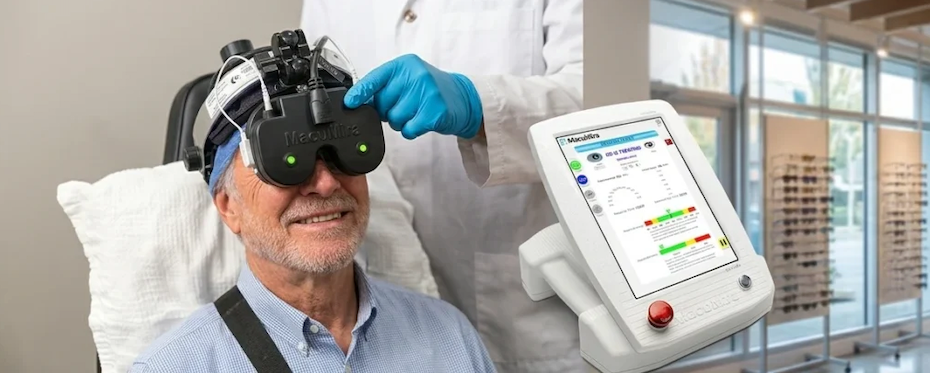
Hollyburn Eye Clinic is pleased to now offer MacuMira protocol in North Vancouver. MacuMira is a non-invasive, Health Canada-licensed Class II medical device that uses microcurrent stimulation to support visual function in people living with dry age-related macular degeneration.
For patients who have been diagnosed with dry AMD, MacuMira provides an additional option that does not involve injections, medication, lasers or surgery.
What Is Dry Age-Related Macular Degeneration?
Age-related macular degeneration, or AMD, is an eye disease that affects the macula, the central portion of the retina responsible for sharp, detailed vision.
The macula plays an important role in activities such as:
- Reading
- Recognizing faces
- Driving
- Seeing fine details
- Working on a computer
- Performing tasks that require precise central vision
There are two main forms of age-related macular degeneration: dry AMD and wet AMD.
Dry AMD is the more common form and typically develops gradually. Changes within the retina, including the accumulation of deposits known as drusen and changes to retinal cells, can progressively affect central vision.
Early dry AMD may produce few noticeable symptoms, which is one reason comprehensive eye examinations become increasingly important as we age.
As dry AMD progresses, patients may notice symptoms such as blurred central vision, reduced contrast, difficulty seeing in dim lighting, trouble reading fine print or needing brighter light to complete everyday tasks.
What Is MacuMira?
MacuMira is a non-invasive protocol designed for people with dry age-related macular degeneration.
The MacuMira System I is licensed by Health Canada as a Class II medical device. Rather than using medication or injections, the technology delivers gentle microcurrent stimulation through the closed eyelids.
The goal is to stimulate retinal activity and support the function of retinal cells involved in vision.
The procedure takes place comfortably in our North Vancouver eye clinic and does not require surgery, injections or downtime.
How Does MacuMira Work?
The retina is one of the most metabolically active tissues in the body. Retinal cells require a significant and continuous supply of energy to function properly.
MacuMira uses precisely controlled, low-level electrical microcurrent delivered through a comfortable headset that rests over the closed eyes.
The microcurrent is designed to stimulate cells within the retinal pigment epithelium, or RPE. These cells play an important role in supporting the photoreceptors responsible for vision.
One area of interest is mitochondrial function. Mitochondria produce adenosine triphosphate, or ATP, which cells use for energy. MacuMira’s microcurrent technology is designed to stimulate retinal cellular activity and support this energy-producing process.
In simple terms, the device is intended to support retinal cells that are still functioning but may not be operating optimally because of dry AMD.
What Does a MacuMira Protocol Feel Like?
It is performed in clinic while you are comfortably seated or reclined. A specialized headset is positioned over your closed eyes. Contoured eye cups deliver gentle microcurrent stimulation through the eyelids.
A typical appointment takes approximately 32 minutes.
Some patients may notice a mild tingling sensation or temporary patterns of light during. Many patients find the experience comfortable and relaxing.
Because MacuMira is non-invasive, there are generally no post-treatment restrictions or downtime. Patients can typically continue with their normal daily activities immediately afterward.
What Is the MacuMira Protocol Schedule?
It typically begins with an initial loading phase consisting of four approximately 32-minute sessions over about 10 days.
After the initial series, ongoing appointments are generally recommended approximately every three months to help maintain the response.
Your exact MacuMira protocol schedule will depend on your eyes, your diagnosis and how your vision responds. Our team will discuss the recommended protocol with you following an assessment.
What Does the Research Say About MacuMira?
MacuMira has been studied in patients with confirmed dry AMD and documented vision loss.
A randomized, sham-controlled clinical study published in the International Journal of Retina and Vitreous in 2023 evaluated microcurrent stimulation using the MacuMira device in 62 participants with dry AMD.
Participants receiving MacuMira protocol demonstrated statistically significant improvements in measures of best-corrected visual acuity compared with the sham-control group at both four weeks and approximately 30 weeks. Improvements in contrast sensitivity were also reported.
The researchers described the findings as encouraging while also acknowledging that additional research is needed to replicate the results and further understand the potential benefits of microcurrent treatment for dry AMD.
It is important to understand that individual responses vary. MacuMira is not a cure for age-related macular degeneration, and improvement cannot be guaranteed.
Why Contrast Sensitivity Matters
When we talk about vision, most people think about how many letters they can read on an eye chart. But visual acuity is only one part of functional vision.
Contrast sensitivity refers to your ability to distinguish an object from its background, particularly when the difference between light and dark is subtle.
Reduced contrast sensitivity can make everyday activities more challenging, including:
- Seeing in low-light conditions
- Driving at night
- Recognizing facial features
- Reading light or low-contrast print
- Navigating stairs and uneven surfaces
This is one reason researchers studying dry AMD look at both visual acuity and contrast sensitivity when evaluating changes in visual function.
Is MacuMira a Cure for Dry AMD?
No. There is currently no cure for dry age-related macular degeneration. MacuMira is designed to support visual function in people with dry AMD rather than eliminate the underlying disease.
Regular monitoring remains extremely important because AMD can progress over time, and dry AMD can develop into wet AMD in some patients.
MacuMira should therefore be considered as one part of an overall AMD management plan rather than a replacement for ongoing eye care.
Can MacuMira Be Used Alongside AREDS2 Vitamins?
Depending on the stage of your AMD and your individual risk factors, your optometrist or ophthalmologist may recommend AREDS2 nutritional supplementation.
MacuMira can be used alongside appropriate nutritional supplements, corrective lenses, low-vision aids and other strategies recommended as part of your AMD management plan.
Your eye doctor at Hollyburn Eye Clinic can help determine which combination of approaches is appropriate for you.
Who May Be a Candidate for MacuMira?
MacuMira is intended for patients with dry age-related macular degeneration, but not everyone with changes to their vision will necessarily be an appropriate candidate.
Before recommending MacuMira protocol, we first need to understand what is happening inside your eyes.
A comprehensive eye examination and appropriate retinal imaging can help us evaluate your macula, determine the type and stage of AMD present and discuss whether MacuMira may be appropriate for you.
This is particularly important because dry and wet AMD are managed differently.
MacuMira is not intended for wet age-related macular degeneration.
The Importance of Monitoring Macular Degeneration
AMD can sometimes progress before significant changes to vision become obvious. Regular comprehensive eye exams allow your eye doctor to examine the retina and macula and identify changes that may not yet be noticeable in everyday life.
If you have already been diagnosed with AMD, your recommended examination schedule will depend on the type and stage of the condition as well as your individual risk factors.
You should also contact your eye care provider promptly if you experience a sudden change in central vision, new distortion, straight lines appearing wavy, a new dark or blank area in your central vision or a sudden reduction in visual clarity.
MacuMira Protocol in North Vancouver
At Hollyburn Eye Clinic, we continue to invest in technology that allows us to offer more comprehensive options for diagnosing and managing eye disease.
We are pleased to now offer MacuMira for dry age-related macular degeneration at our North Vancouver clinic.
For patients who have previously been told that their dry AMD primarily needs to be monitored, the development of non-invasive options represents an important area of progress in retinal care. The first step is determining whether the MacuMira is appropriate for your individual eyes.
Learn Whether MacuMira May Be Right for You
If you or a family member has been diagnosed with dry age-related macular degeneration, we invite you to speak with our team about MacuMira.
A comprehensive assessment allows us to evaluate your eye health, discuss your current AMD management plan and determine whether MacuMira may be an appropriate option.
Learn more about MacuMira for dry AMD at Hollyburn Eye Clinic or request an appointment with our North Vancouver team.
Individual results vary. MacuMira is not a cure for dry AMD, and improvement in vision cannot be guaranteed.