
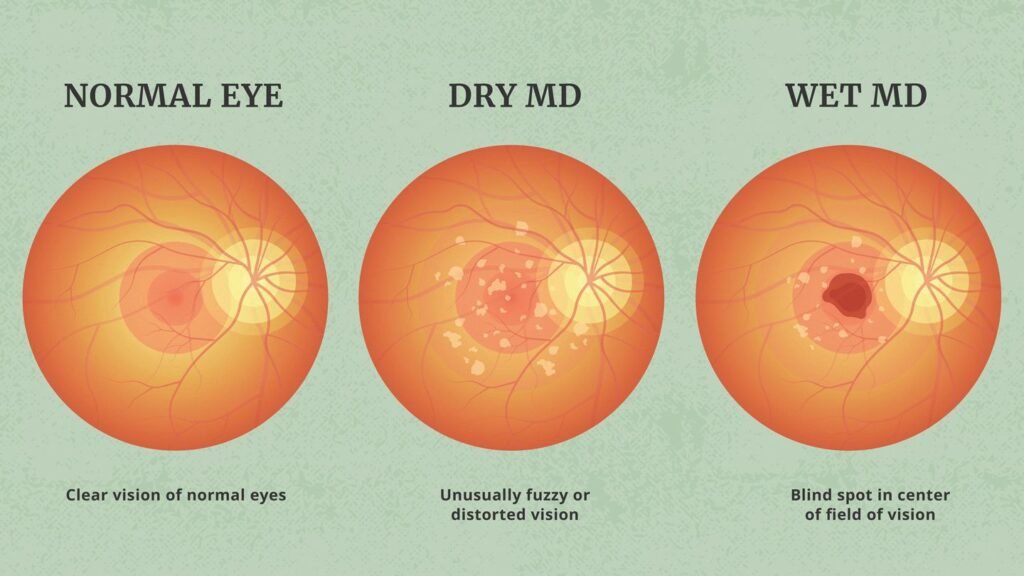
Age-related macular degeneration, commonly called AMD, is one of the leading causes of vision loss in older adults. But an AMD diagnosis does not look the same for everyone.
There are two main forms of age-related macular degeneration: dry AMD and wet AMD.
Both affect the macula, the small central portion of the retina responsible for detailed, straight-ahead vision. However, dry and wet AMD develop differently, can progress at different speeds and require different approaches to monitoring and treatment.
Understanding the difference is particularly important if you or a family member has recently been diagnosed with macular degeneration.
At Hollyburn Eye Clinic in North Vancouver, we monitor and manage patients with age-related macular degeneration and can help you better understand what type of AMD you have, how it may affect your vision and what management options may be appropriate.
What Is Age-Related Macular Degeneration?
The retina is the light-sensitive tissue at the back of the eye. At its centre is an area called the macula, which provides the detailed central vision we rely on every day.
Your macula helps you:
- Read
- Recognize faces
- Drive
- See fine details
- Use a computer or phone
- Distinguish colours and contrast
- Complete tasks requiring precise central vision
Age-related macular degeneration develops when changes within the macula begin to affect this central vision.
Importantly, AMD generally affects central rather than peripheral vision. Even advanced AMD does not typically cause complete blindness, but significant central vision loss can make activities such as reading, driving and recognizing faces much more difficult.
Early AMD may also cause no noticeable symptoms, which is one reason regular comprehensive eye examinations become increasingly important as we age. The National Eye Institute notes that some people can have early AMD for a considerable period before noticing changes to their vision.
What Is Dry AMD?
Dry AMD, also known as atrophic AMD, is the more common form of age-related macular degeneration.
It develops as the tissues within the macula gradually change with age. One of the signs eye doctors look for is the presence of drusen, small deposits that accumulate beneath the retina.
Having a few small drusen does not necessarily mean someone has AMD. However, changes in the number and size of drusen, along with other retinal changes, can help an eye doctor determine whether AMD is present and how advanced it may be.
Dry AMD typically progresses more gradually than wet AMD and is generally classified into three stages:
Early Dry AMD
People with early dry AMD frequently have no symptoms. Changes may only be discovered when the retina is examined during a comprehensive eye exam.
Intermediate Dry AMD
Some people with intermediate AMD still experience few symptoms, while others begin noticing changes such as:
- Mild blurring of central vision
- Difficulty seeing in dim lighting
- Needing brighter light for reading
- Reduced contrast
- Difficulty adapting when moving between bright and dark environments
- Late Dry AMD
Advanced dry AMD can lead to more significant deterioration of the retinal cells responsible for central vision.
One advanced form is known as geographic atrophy, in which areas of retinal tissue gradually deteriorate.
This can result in missing, blurry or distorted areas within the central field of vision.
Dry AMD often progresses gradually over several years, although the rate of progression can vary significantly between individuals.
What Is Wet AMD?
Wet AMD, also called neovascular AMD, is less common but can cause more rapid changes to vision.
With wet AMD, abnormal blood vessels develop underneath or within the retina. These fragile blood vessels can leak fluid or blood into the macula, disrupting its normal structure and affecting central vision.
Unlike the typically gradual progression associated with dry AMD, symptoms of wet AMD can sometimes develop quickly.
Potential warning signs include:
- Sudden central blurring
- Straight lines appearing wavy or distorted
- A new dark or blank area in central vision
- Difficulty recognizing faces
- A noticeable reduction in visual clarity
- Objects appearing distorted in size or shape
The Canadian Association of Optometrists notes that wet AMD can progress rapidly and emphasizes contacting an eye care professional when new vision changes occur.
Dry AMD vs. Wet AMD: A Quick Comparison
| Dry AMD | Wet AMD | |
|---|---|---|
| How common is it? | The more common form | Less common |
| How does it develop? | Gradual degenerative changes within the macula | Abnormal blood vessels grow and leak beneath or within the retina |
| Typical progression | Often gradual | Can progress rapidly |
| Early symptoms | May have no symptoms | Changes can sometimes appear suddenly |
| Central vision | May gradually become blurry, reduced or distorted | May suddenly become blurry or distorted |
| Straight lines appearing wavy | Can occur, particularly in advanced disease | Important warning sign requiring prompt assessment |
| Management | Depends on stage and individual risk factors | Often requires treatment by a retinal specialist |
| Can it affect both eyes? | Yes | Yes |
Although these differences are helpful for understanding AMD, symptoms alone cannot determine whether someone has dry or wet AMD. Examination and retinal imaging are needed to understand what is happening inside the eye.
Can Dry AMD Turn Into Wet AMD?
Yes. A person with dry AMD can develop wet AMD, and this change can occur in one or both eyes.
Wet AMD is considered an advanced form of AMD. The National Eye Institute notes that any stage of dry AMD can develop into wet AMD, which is one reason ongoing monitoring is so important after an AMD diagnosis.
Someone who has had stable dry AMD for years should therefore still pay attention to new changes in vision.
A sudden change should never simply be assumed to be part of normal aging.
Why Do Straight Lines Look Wavy With Macular Degeneration?
One of the most recognizable symptoms associated with advanced AMD is visual distortion.
A door frame, window blind, piece of graph paper or line of text that should appear straight may suddenly look bent, curved or wavy.
This type of distortion is sometimes called metamorphopsia.
It can occur when structural changes within the macula interfere with the way retinal cells perceive an image.
If straight lines suddenly begin appearing distorted, especially if you already have AMD, contact your eye care provider promptly. The National Eye Institute identifies new wavy or crooked lines as an important warning sign of late AMD.
How Is AMD Diagnosed?
Age-related macular degeneration can be detected as part of a comprehensive eye examination.
At Hollyburn Eye Clinic, assessing ocular health is an important part of our comprehensive exams. Regular examinations are particularly valuable because eye diseases such as macular degeneration can be present before patients experience significant vision loss.
Depending on your eye health and individual circumstances, evaluating the macula may involve examination of the retina and additional retinal imaging.
One commonly used imaging technology is optical coherence tomography, or OCT.
OCT creates detailed cross-sectional images of the retina and can help eye care professionals evaluate its different layers and identify structural changes associated with conditions such as AMD.
The goal is not simply to determine whether AMD is present. Your eye doctor also needs to understand which type of AMD you have, its stage and whether there have been changes over time.
How Is Dry AMD Managed?
Management of dry AMD depends on its stage, your overall eye health and your individual risk factors.
Your eye doctor may recommend a combination of:
Regular Eye Examinations and Retinal Monitoring
Because AMD can change over time, regular monitoring allows your eye doctor to look for progression and identify new concerns.
Monitoring Your Vision at Home
Some patients with AMD may be advised to use an Amsler grid to monitor central vision between appointments.
An Amsler grid contains a pattern of straight horizontal and vertical lines. Changes such as new distortion, missing areas or waviness can indicate a change in central vision.
Home monitoring does not replace professional eye examinations, but it can help some patients identify changes between appointments.
AREDS2 Nutritional Supplements
Depending on the stage of AMD, an eye doctor may recommend a specific combination of vitamins and minerals known as the AREDS2 formula.
AREDS2 supplementation is not appropriate for every patient and is not simply a general-purpose eye vitamin. Its potential benefit depends in part on the stage of AMD present.
This is why supplements for macular degeneration should ideally be discussed with your eye care professional rather than started based solely on an AMD diagnosis.
Lifestyle and Overall Health
Supporting cardiovascular and overall health may also play a role in AMD management.
Smoking is an important modifiable risk factor for age-related macular degeneration. Maintaining healthy blood pressure, remaining physically active and eating a nutrient-rich diet that includes leafy green vegetables and fish are also among the healthy habits recommended by the National Eye Institute.
What Is MacuMira for Dry AMD?
Another option now available at Hollyburn Eye Clinic for appropriate patients with dry AMD is MacuMira.
MacuMira is a non-invasive microcurrent technology designed to support visual function in people living with dry age-related macular degeneration.
Treatment uses controlled low-level microcurrent delivered through a headset positioned over the closed eyes. Unlike treatments involving injections or surgery, MacuMira treatment is performed non-invasively in the clinic.
Because every case of AMD is different, MacuMira is not automatically appropriate for every person diagnosed with dry AMD.
An assessment is the first step in determining your type and stage of macular degeneration and discussing whether MacuMira may have a role within your individual AMD management plan.
You can learn more on our MacuMira for Dry AMD treatment page.
How Is Wet AMD Treated?
Wet AMD requires a different treatment approach.
The most common medical treatment for wet AMD is a group of medications known as anti-VEGF drugs.
VEGF stands for vascular endothelial growth factor, a protein involved in the formation of new blood vessels. In wet AMD, VEGF contributes to the growth of abnormal blood vessels underneath or within the retina.
Anti-VEGF medication is injected into the eye to help reduce abnormal blood vessel activity, leakage and bleeding.
Depending on the individual case, repeated treatments may be required.
Photodynamic therapy is another treatment that may be used in selected situations, although the National Eye Institute notes that anti-VEGF injections are the most commonly used treatment for wet AMD.
Patients requiring treatment for wet AMD may be referred to an ophthalmologist or retinal specialist for appropriate management.
Why Wet AMD Symptoms Should Be Assessed Quickly
One of the biggest differences between dry and wet AMD is the potential speed of vision change.
Dry AMD often changes gradually.
Wet AMD can sometimes change much more quickly.
If you notice a sudden change in your central vision, particularly new distortion, waviness, a dark spot or unexplained central blurring, do not wait until your next routine eye exam.
Prompt assessment can determine whether a change in the retina has occurred and whether further treatment or referral is required.
Hollyburn Eye Clinic also provides assessment for urgent eye concerns in North Vancouver.
Does AMD Cause Complete Blindness?
This is a common concern after receiving an AMD diagnosis.
AMD affects the macula and therefore primarily affects central vision.
Even advanced AMD usually does not eliminate all peripheral vision. However, significant central vision loss can still have a major impact on independence and everyday activities.
Reading, driving, recognizing faces and completing detailed tasks may become increasingly difficult.
For people who develop significant vision impairment, low-vision devices, magnification and vision rehabilitation strategies can help make better use of remaining vision.
Can Glasses Correct Vision Loss From AMD?
A new glasses prescription may improve vision when refractive error is contributing to blur, but glasses cannot reverse damage to retinal cells caused by macular degeneration.
This is an important distinction.
If someone with AMD notices worsening vision, simply increasing the strength of a glasses prescription may not solve the underlying problem.
Instead, the change should be assessed to determine whether the AMD itself has progressed or whether another eye condition is contributing to the change.
Why Regular Eye Exams Matter
One of the challenges with AMD is that early disease may exist before you realize anything has changed. You cannot rely solely on symptoms to know whether your macula is healthy.
Comprehensive eye examinations allow your optometrist to evaluate both your vision and the health of the structures inside your eyes. For patients who have already been diagnosed with AMD, ongoing examinations and retinal monitoring can also help identify progression and determine whether your management plan needs to change.
Dry AMD and Wet AMD Care in North Vancouver
If you have been diagnosed with age-related macular degeneration, understanding whether you have dry AMD or wet AMD is an important first step.
Dry and wet AMD affect the macula differently, progress differently and require different approaches to management.
At Hollyburn Eye Clinic in North Vancouver, our team provides comprehensive eye examinations, retinal health assessment and ongoing management for patients living with macular degeneration.
We also now offer MacuMira for appropriate patients with dry AMD, providing another option to discuss as part of an individualized dry AMD management plan.
If you have been diagnosed with macular degeneration, have a family history of AMD or have noticed changes to your central vision, request an appointment with Hollyburn Eye Clinic.
And if you experience a sudden change in your vision, new distortion or straight lines appearing wavy, contact Hollyburn Eye Clinic promptly rather than waiting for your next routine examination.